
Efficacy Data

THE FIRST AND ONLY ANTI‑CD20 TO ACHIEVE AN ARR OF <0.1 IN TWO PHASE 3 CLINICAL TRIALS1,2,a
Efficacy Data
THE FIRST AND ONLY ANTI‑CD20 TO ACHIEVE AN ARR OF <0.1 IN TWO PHASE 3 CLINICAL TRIALS1,2,a
Actor Portrayal. Image retouched using AI.
Efficacy Data
THE FIRST AND ONLY ANTI‑CD20 TO ACHIEVE AN ARR OF <0.1 IN TWO PHASE 3 CLINICAL TRIALS1,2,a
Actor Portrayal. Image retouched using AI.
Efficacy Data
THE FIRST AND ONLY ANTI‑CD20 TO ACHIEVE AN ARR OF <0.1 IN TWO PHASE 3 CLINICAL TRIALS1,2,a
Actor Portrayal. Image retouched using AI.

aARR for BRIUMVI observed in the ULTIMATE I and II Phase 3 clinical trials. Cross-trial comparisons are not appropriate given variation in patient populations enrolled across different trials.
I was interested to see the long‑term data, and the BRIUMVI open-label extension data was very informative.
Jacqueline Rosenthal, MD
Individual featured has been compensated by TG Therapeutics.
I was interested to see the long-term data, and the BRIUMVI open-label extension data was very informative.
Jacqueline Rosenthal, MD

Individual featured has been compensated by TG Therapeutics.

ARR from ULTIMATE I and II.1,2 Based on mITT population. The mITT population consists of all subjects in the ITT population who received at least 1 dose of study medication and had at least 1 baseline and post baseline efficacy assessment.
ARR, annualized relapse rate; ITT, intention-to-treat; mITT, modified intention-to-treat.
ULTIMATE I:
<1 relapse for every 13 patient‑years with BRIUMVI3
ULTIMATE II:
<1 relapse for every 11 patient‑years with BRIUMVI3
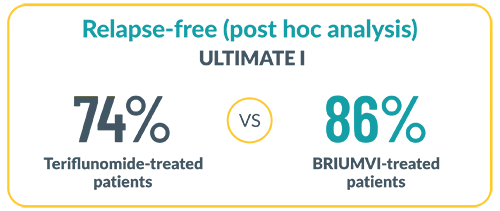
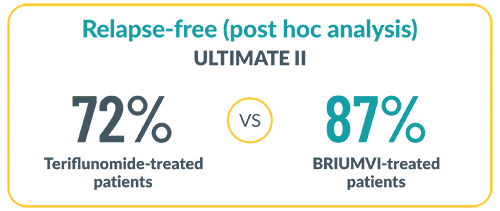
Annualized Relapse Ratea
PRIMARY ENDPOINT
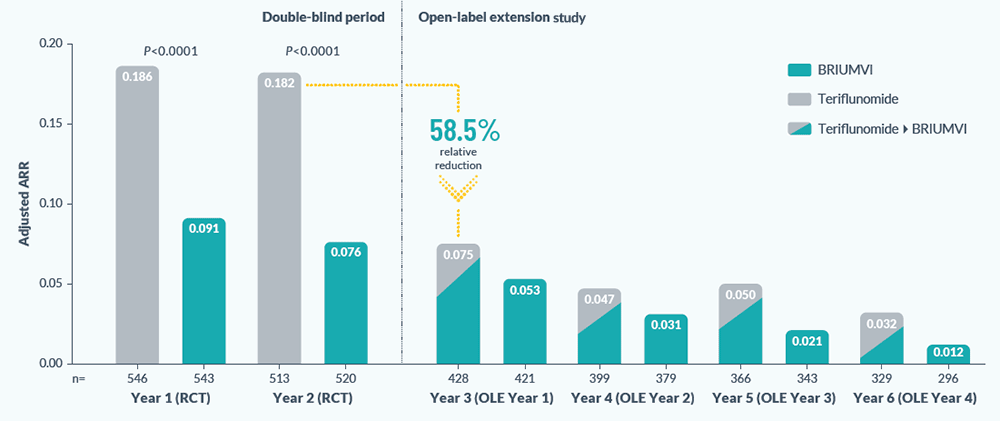
ARR for BRIUMVI observed in the 4-year OLE.5 For patients who switched from teriflunomide to BRIUMVI, an additional post hoc analysis was conducted that showed a relative reduction in ARR of 58.5% from Year 2 to Year 3.
The OLE trial was designed to evaluate the long-term efficacy and safety of BRIUMVI and lacked a control group; results of the OLE trial should be interpreted with caution.
OLE, open-label extension.
aBased on pooled data from 2 studies.
I like that the BRIUMVI maintenance infusions are 1 hour twice per year following the starting dose, and my 6‑month MRI and checkup showed no new lesions in my brain or spine. With BRIUMVI, I only think about my next dose every 6 months, and those infusions have only been 1 hour.
Meaghan, living with RMS and taking BRIUMVI
People featured have been compensated by TG Therapeutics for their time. Individual results may vary.
RMS, relapsing forms of multiple sclerosis.
I like that the BRIUMVI maintenance infusions are 1 hour twice per year following the starting dose, and my 6‑month MRI and checkup showed no new lesions in my brain or spine. With BRIUMVI, I only think about my next dose every 6 months, and those infusions have only been 1 hour.
Meaghan, living with RMS and taking BRIUMVI

People featured have been compensated by TG Therapeutics for their time. Individual results may vary.
RMS, relapsing forms of multiple sclerosis.
GD+ T1 LESIONS WERE SUPPRESSED BY 97% COMPARED WITH TERIFLUNOMIDE1,2
SECONDARY ENDPOINT

Mean number of T1 Gd+ lesions per MRI for teriflunomide-treated patients and BRIUMVI-treated patients in ULTIMATE I and II. Based on MRI-mITT population (ie, mITT patients who had baseline and postbaseline MRI).
T2 LESIONS WERE SUPPRESSED BY 92% IN ULTIMATE I AND 90% IN ULTIMATE II COMPARED WITH TERIFLUNOMIDE1,2
SECONDARY ENDPOINT

Mean number of T2 lesions per MRI for teriflunomide-treated patients and BRIUMVI-treated patients in ULTIMATE I and II. Based on MRI-mITT population (ie, mITT patients who had baseline and postbaseline MRI).
Gd+, gadolinium-enhancing; MRI, magnetic resonance imaging.
When new lesions showed up on my MRI, my doctor gave me several high‑efficacy options, and I chose BRIUMVI. As a husband and dad, the 1‑hour BRIUMVI maintenance infusion has worked well for me and my schedule. I just had my fifth infusion, and I am doing well.
David, living with RMS and taking BRIUMVI
People featured have been compensated by TG Therapeutics for their time. Individual results may vary.
When new lesions showed up on my MRI, my doctor gave me several high‑efficacy options, and I chose BRIUMVI. As a husband and dad, the 1‑hour BRIUMVI maintenance infusion has worked well for me and my schedule. I just had my fifth infusion, and I am doing well.
David, living with RMS and taking BRIUMVI

People featured have been compensated by TG Therapeutics for their time. Individual results may vary.
12-Week CDP

24-Week CDP
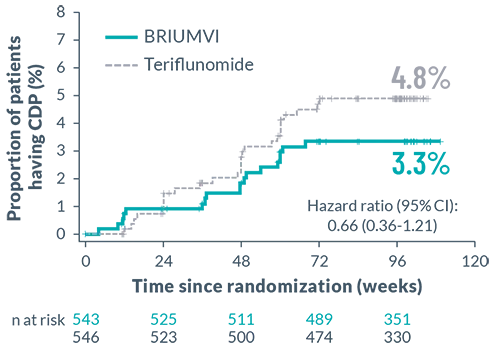
Kaplan-Meier estimates of the percentages of participants in the mITT population with worsening of disability confirmed at Week 12 and Week 24. Disease progression was defined as an increase of ≥1.0 point from the baseline EDSS score if the baseline score was ≤5.5, or an increase of ≥0.5 points if the baseline score was >5.5. CDP at Week 12 between the 2 treatment groups did not reach statistical significance, and CDP at Week 24 was not formally tested for significance. Prespecified pooled analysis.
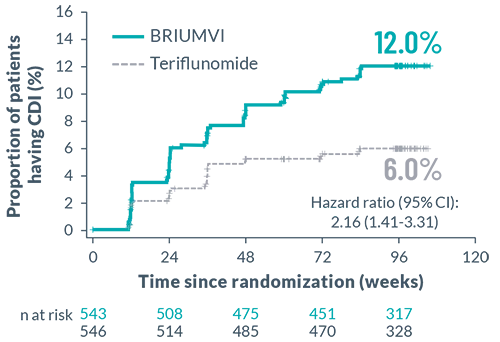
12-Week CDI
24-Week CDI
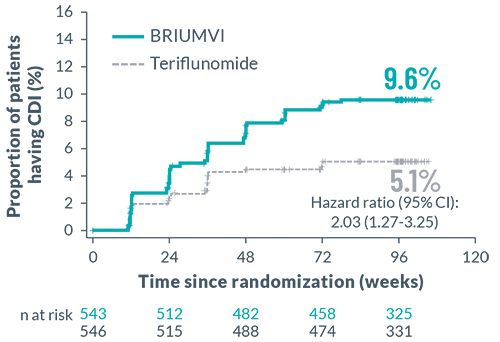
Kaplan-Meier estimates of the percentages of participants in the mITT population with lessening disability confirmed at Week 12 and Week 24. Disability improvement was measured by EDSS and defined as a reduction of ≥1.0 point from the baseline EDSS score, or a reduction of ≥0.5 points if the baseline EDSS score was >5.5. CDI at Weeks 12 and 24 was not formally tested for significance. Prespecified pooled analysis.
CDI, confirmed disability improvement;
CDP, confirmed disability progression;
EDSS, Expanded Disability Status Scale.
| 95% | of all BRIUMVI patients in the ULTIMATE I and II trials experienced no 12-week CDP1,2 |
95%
of all BRIUMVI patients in the ULTIMATE I and II trials experienced no 12-week CDP1,2
NEDA-3 is defined as patients with:
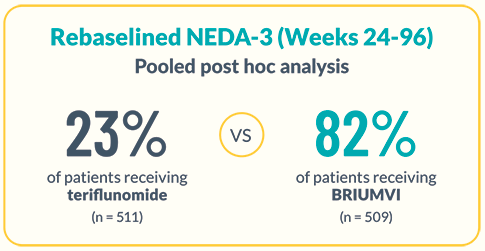
Rebaselining NEDA7:

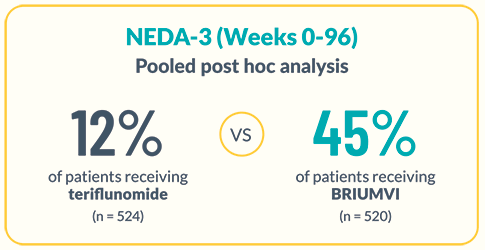
NEDA-3 (Weeks 0-96)
Rebaselined NEDA-3 (Weeks 24-96)
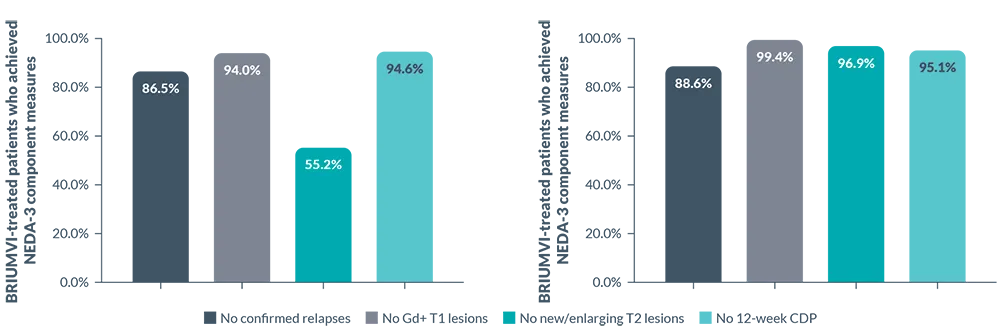
Percentage of patients treated with BRIUMVI achieving individual component measures of NEDA-3 and rebaselined NEDA-3.
DMT, disease-modifying therapy; NEDA, no evidence of disease activity.
aLimitations of NEDA in ULTIMATE I and ULTIMATE II: The predefined secondary endpoint was not statistically significant, and it was considered nonconfirmatory because it fell below the break in the statistical hierarchy at the time of 12-week CDP during the 96-week treatment period. No conclusions can be drawn.
HIGHLY ACTIVE SUBPOPULATION ANALYSIS
Limitations: Post hoc pooled analyses of ULTIMATE I and II (Phase 3) evaluated outcomes at Weeks 12 and 96 in participants with highly active disease. Limitations include the post hoc design, small sample size, and potential differences from real-world populations. Conclusions about safety or efficacy cannot be drawn based on these data.
15% of patients from ULTIMATE I and II had highly active disease8
HIGHLY ACTIVE DISEASE IN THIS ANALYSIS WAS DEFINED AS8:
Relative reduction in ARR at Week 96 in the highly active subpopulation vs teriflunomide8

aBased on mITT population.
Early radiological assessment of Gd+ T1 and new/enlarging T2 lesions in patients with highly active disease at Week 128,b


Gd+ T1 and new/enlarging T2 lesions in patients with highly active disease at Week 968

bBased on mITT-MRI population.
TREATMENT-NAÏVE SUBPOPULATION ANALYSIS
Limitations: The post hoc nature of the analyses; the definition of the treatment-naïve group as participants who had received no prior approved DMT within 5 years before enrollment; and the possibility that participants enrolled in the controlled trials may differ from the real-world population.
66% OF PATIENTS FROM ULTIMATE I AND II WERE TREATMENT-NAÏVE9
TREATMENT-NAÏVE POPULATION IN THIS ANALYSIS WAS DEFINED AS:
Participants who had not received an approved DMT in the 5 years prior to study enrollment.9
EARLY TREATMENT SUBPOPULATION IN THIS ANALYSIS WAS DEFINED AS:
A subset of treatment-naïve participants who had their first MS symptom ≤3 years prior to enrollment at Week 96.9
Relative reduction in ARR compared with teriflunomide in the treatment-naïve population and the early treatment subpopulation9,a

aBased on mITT population.
Relative reductions in Gd+ T1 and new/enlarging T2 lesions observed in treatment-naïve population and early treatment subpopulation9

Based on mITT-MRI population.
References: 1. BRIUMVI. Prescribing information. TG Therapeutics Inc; 2026. 2. Steinman L, Fox E, Hartung H-P, et al. Ublituximab versus teriflunomide in relapsing multiple sclerosis. N Engl J Med. 2022;387(8):704-714. 3. Data on file. TG Therapeutics, Inc; 2026. 4. Steinman L, Fox EJ, Hartung H-P, et al. Relapse rate and time to first relapse were improved with ublituximab vs teriflunomide in the phase 3 ULTIMATE I and ULTIMATE II studies in patients with relapsing multiple sclerosis (RMS). Presented at: 2022 American Academy of Neurology Annual Meeting; April 2-7, 24-26, 2022; Seattle, WA. 5. Cree BAC, Fox E, Hartung H-P, et al. Long-term efficacy and safety of ublituximab in relapsing multiple sclerosis: results from 6 years of ULTIMATE I and II open-label extension. Presented at: ECTRIMS; September 24-26, 2025; Barcelona, Spain. 6. Alvarez E, Steinman L, Fox EJ, et al. Improvements in no evidence of disease activity with ublituximab vs teriflunomide in the ULTIMATE phase 3 studies in relapsing multiple sclerosis. Front Neurol. 2024;15:1473284. 7. Giovannoni G, Turner B, Gnanapavan S, Offiah C, Schmierer K, Marta M. Is it time to target no evidence of disease activity (NEDA) in multiple sclerosis? Mult Scler Relat Disord. 2015;4(4):329-333. 8. Hartung H-P, Robertson D, Steinman L, et al. Efficacy of ublituximab in people with highly active relapsing multiple sclerosis. Neurol Ther. 2026;15:1081-1097. 9. Robertson D, Alvarez E, Steinem L, et al. Disease outcomes with ublituximab in treatment-naïve participants: subpopulation analyses of the phase 3 ULTIMATE I and II studies in participants with relapsing multiple sclerosis. Front Immunol. 2026;29:17:1771848.
